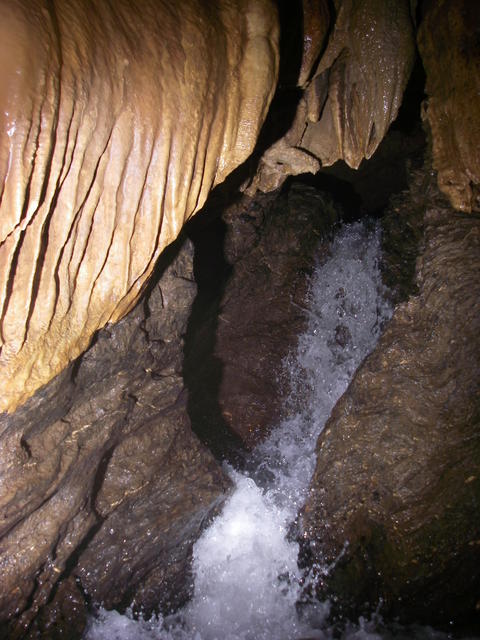
(photo courtesy of William Kromhout)
The hypogean (subterranean) Crustacea recording scheme is a small scheme dealing with the subterranean macro-Crustacea (Malacostraca) found in the groundwater and aquatic cave habitats of the British Isles, including Ireland. The scheme only encompasses the (mostly) larger Crustacea specifically evolved to exist in underground aquatic habitats (stygobites). Adaptations to the underground aquatic environment typically involve a lack of pigment (i.e. specimens are white in colour), a lack of eyes and over-development of antennae and legs. Most species are also quite small and/or have a thin body shape for squeezing between small water-filled crevices in underground rock strata and water-logged gravels.
Specimens of the ubiquitous epigean (surface-dwelling) freshwater shrimp Gammarus pulex are often recorded in caves but are usually washed in from the surface, although some isolated stygophilic populations have been recorded. In Ireland a similar case exists with Gammarus duebeni celticus. Both of these species are not included in the scheme.
The scheme also does not cover the micro-Crustacea (Copepoda, Ostracoda, Cladocera etc.). Amongst the micro-crustaceans there are several species that have been recorded from cave and groundwater habitats but it is thought that the copepod Acanthocyclops sensitivus is the only true sygobitic copepod in Britain, whilst the stygobitic ostracods Fabaeformiscandona breuili and F. wegelini have also recently been recorded from Ireland and Britain (Knight & Mori, 2022). Proudlove et. al. (2003) includes the various micro-Crustacea besides the subterranean Malacostraca, and discusses their distributions and hypogean status, as well as the occurrence of Gammarus species underground. Knight & Mori (2022) update the records of subterranean Ostracoda, including seveeral important new records from the last two decades.
The eleven stygobitic Malacostraca Crustacea recorded from Britain and Ireland are listed below.
| Superorder | Order | Family | Species | Authority |
| Syncarida | Bathynellacea | Bathynellidae | Antrobathynella stammeri | Jakobi, 1954 |
| Bathynella natans | Vejdoysky, 1882 | |||
| Peracarida | Amphipoda | Niphargidae | Niphargus aquilex | Schiődte, 1855 |
| Niphargus fontanus | Bate, 1859 | |||
| Niphargus glenniei | Spooner, 1952 | |||
| Niphargus kochianus | Bate, 1859 | |||
| Niphargus irlandicus | Schellenberg, 1932 | |||
| Niphargus wexfordensis | Karaman, Gledhill & Holmes, 1994 | |||
| Pseudoniphargidae | Microniphargus leruthi | Schellenberg, 1934 | ||
| Peracarida | Amphipoda | Crangonycitidae | Crangonyx subterraneus | Bate, 1859 |
| Peracarida | Isopoda | Asellidae | Proasellus cavaticus | Leydig, 1871 sensu Henry, 1970 |
References and further reading
ANDERSON, R.O. (1959). A modified flotation technique for sorting bottom fauna samples. Limnol. Oceanogr., 4: 223-225.
ARNSCHEIDT, J., DOOLEY, J., ERIKSSON, K., HACK, C., HAHN, H.J., HIGGINS, T., McCARTHY, T.K., McINERNEY, C. & WOOD, P. (2012). Biogeography and Ecology of Irish Groundwater Fauna: assessment of the distribution, structure and functioning of subterranean fauna within Irish groundwater systems (2007-W-MS-1-S1) STRIVE Report. Environmental Protection Agency STRIVE Report Series No. 95, EPA STRIVE Programme 2007-2013. https://www.epa.ie/pubs/reports/research/water/STRIVE_95_web.pdf
ARNSCHEIDT, J., HAHN, H.J. & FUSCHS, A. (2008). Aquatic subterranean Crustacea in Ireland: results and new records from a pilot study. Cave and Karst Science, 35 (1 & 2): 53-58..
BATE, C. S. (1859). On the genus Niphargus (Schiodte). Proceedings of the Dublin University Zoological & Botanical Association, 1: 237-240.
BOU, C. & ROUCH, R. (1967). Un noveau champ de recherches sur la faune aquatique souterraine. C. R. Aca. Sci. Paris, 256: 369-370
BRATTON, JH (Ed) (1991). British Red Data Books: 3. Invertebrates other than Insects. Joint Nature Conservation Committee: 253pp.
BRATTON, J.H. (2006) Occurrence of the well shrimp Niphargus aquilex (Crustacea: Niphargidae) in Anglesey, North Wales, UK. Cave and Karst Science, 33 (1): 29-30.
CAMACHO, A.I. (1992). Sampling the subterranean biota cave (aquatic environment). 135-168 in Camacho, A.I. (ed.). The natural history of biospeleology (Monografias Museo Nacional de Cicencas Naturales).
CAMACHO, A.I., MAS-PEINADO, P., DORDA, B.A., CASADO, A., BRANCELJ, A., KNIGHT, L.R.F.D., HUTCHINS, B., BOU, C., PERINA, G. & REY, I. (2017) Molecular tools unveil an underestimated diversity in a stygofauna family: a preliminary world phylogeny and an updated morphology of Bathynellidae (Crustacea: Bathynellacea). Zoological Journal of the Linnean Society, XX: 1-27.
CHAPMAN, P. (1993). Caves and Cave Life. Harper Collins, New Naturalist Series: 219pp.
CHAPPUIS, P.A. (1942). Eine neue methode zur untersuchung der grundwasserfauna. Act. Scientiarum Math. Nat. Kolozsvar, 6: 1-7.
COLEMAN, M.J. & HYNES, H.B.N. (1970). The vertical distribution of the invertebrate fauna in the bed of a stream. Limnol. Oceanogr. 15 (1): 31-40.
COSTELLO, M.J. (1993). Biogeography of alien amphipods occurring in Ireland, and interactions with native species. Crustaceana, 65: 287-299.
CULVER, D.C. & PIPAN, T. (2009) The Biology of Caves and Other Subterranean Habitats. Oxford University Press; The Biology of Habitats Series: 254pp.
CULVER, D.C. and PIPAN, T. (2019). The Biology of Caves and Other Subterranean Habitats, Second Edition. Oxford University Press, Oxford: 301pp.
CULVER, D.C. & PIPAN, T. (2014) Shallow Subterranean Habitats: Ecology, Evolution and Conservation. Oxford University Press; The Biology of Habitats Series: 258pp.
DRIVER, D.B. (1963). Some simple techniques and apparatus for the collection and preservation of animals from cave habitats. Transactions of the cave Research group of Great Britain, 6 (2): 91-101.
FIŠER, C., SKET, B. & TRONTELJ, P. (2008). A phylogenetic perspective on 160 years of troubled taxonomy of Niphargus (Crustacea: Amphipoda). Zoologica Scripta, 37 (6): 665-680.
FIŠER, C., TRONTELJ, P, LUŠTRIK, R. & SKET, B. (2009). Toward a unified taxonomy of Niphargus (Crustacea: Amphipoda): a review of morphological variability. Zootaxa, 2061: 1-22.
GIBERT, J., DANIELOPOL, D.L. & STANFORD, J.A. (eds.) (1994). Groundwater Ecology. Aquatic Biology Series, Academic Press: 571pp.
GINET, R. (1960). Écologie, Éthologie et biologie de Niphargus (Amphipodes Gammarides hypogés). Annales de Spéléologie, 15: 127-376.
GINET, R. (1996). Bilan systematique du genre Niphargus en France. Lyon Societe Linneene de Lyon and Hydrobiologie et Ecologie Souterraines, Universite Claude Bernard: 243pp.
GLEDHILL, T. (1977). Numerical fluctuations of four species of subterranean amphipods during a five-year period. Crustaceana Supplement, No. 4: 144-152.
GLEDHILL, T. (1980). Designation and description of the lecotype of Niphargus fontanus Bate. Crustaceana Supplement, No. 6: 27-37.
GLEDHILL, T. & DRIVER, D.B. (1964). Bathynella natans Vejdovsky (Crustacea: Syncarida) and its Occurrence In Yorkshire. The Naturalist, July - September: 104 - 106.
GLEDHILL, T. & GLEDHILL, J. (1984). Discovery of Bathynella, a subterranean freshwater syncarid crustacea, in Ireland. Irish Naturalists Journal, 21: 313-317.
GLEDHILL, T. & LADLE, M. (1969). Observations on the life history of the subterranean amphipod Niphargus aquilex Schiödte. Crustaceana, 16: 51-56.
GLEDHILL, T., SUTCLIFFE, D. W. & WILLIAMS, W.D. (1993). British Freshwater Crustacea Malacostraca: A Key with Ecological Notes. FBA Scientific Publication No. 52:173pp.
GLENNIE, E.A. (1956). A Brief Account of the Hypogean Amphipoda of the British Isles. Premier Congres International De Spelelogie, Paris, 1953: 61 - 63.
GLENNIE, E.A. (1956). Cave Fauna. 10th Anniversary Publication of the South Wales Caving Club: 24-36.
GLENNIE, E.A. (1967). The Distribution of the Hypogean Amphipoda in Britain. Transactions of the Cave Research Group of Great Britain, 9: 132 - 136.
GUNN, J. HARDWICK, P & WOOD, P J. (2000). The invertebrate community of the Peak–Speedwell cave system, Derbyshire, England – pressures and considerations for conservation management. Aquatic Conservation: Marine and Freshwater Ecosystems, 10: 353–369.
HÄNFLING, B., DOUTERELO-SOLER, I. KNIGHT, L. & PROUDLOVE, G. (2008). Molecular studies on the Niphargus kochianus group (Crustacea: Amphipoda: Niphargidae) in Great Britain and Ireland. Cave and Karst Science, 35 (1 & 2): 35-40.
HARTKE, T.R., FIŠER, C., HOHAGEN, J., KIEBER, S., HARTMANN, R. & KOENEMANN, S. (2011) Morphological and molecular analyses of closely related species in the stygobiontic genus Niphargus (Amphipoda). Journal of Crustacean Biology, 31 (4): 701-709.
HAZELTON, M. (1975). The biology of the Mendip caves: 313-351 in Smith, D.I. & Drew, D.P. (eds.) Limestone and Caves of the Mendip Hills (David & Charles for British Cave Research Association).
HAZELTON, M. & GLENNIE, E.A. (1953). Cave fauna and flora: 247-284 in Cullingford, C.H.D. (ed.) British caving, an introduction to speleology (Routledge and Kegan Paul Ltd.).
HENRY, J.P. & MAGNIEZ, G. (1970). Contribution à la systématique des Asellides (Crustacea Isopoda). Annales de Spéléologie, 25: 335-367.
HENRY, J.P. & MAGNIEZ, G. (1983). Crustacea Isopodes (principalement Asellotes). Bulletin de la Société Linneenne de Lyon, 52nd Anneè, 10: 319-357.
HOGAN, A.R. (1859). On the habits and localities of Niphargus fontanus (n s), N. kochianus (n s) and Crangonyx subterraneus (n g & n s) Spence Bate. Natural History Review and Quarterly Journal of Science, 6: 166-169.
JEFFERSON, G.T. (1969). British Cave Faunas and the Problem of Their Food Supply. Proceedings Of The 4th International Congress Of Speleology, Yugoslavia (1965), 4-5: 129 - 133.
JEFFERSON, G.T. (1989). Cave biology in South Wales:56-69 in Ford, T. (ed.). Limestones and Caves of Wales (Cambridge University Press).
JEFFERSON, G.T. & CHAPMAN, P.R.J. (1979). Studies on the invertebrate fauna of the Ogof Ffynnon Ddu cave system. Nature Conservancy Council Research Report.
JEFFERSON, G.T., CHAPMAN, P., CARTER, J. & PROUDLOVE, G. (2004). The invertebrate fauna of the Ogof Ffynnon Ddu cave system, Powys, South Wales, UK. Cave and Karts Science 31 (2): 63-76.
JOHNS, T., IWAN JONES, J., KNIGHT, L., MAURICE, L. WOOD, P. & ROBERTSON, A. (2015) Regional-scale drivers of groundwater faunal distributions. Freshwater Science, 34 (1): 316-328.
JUDSON WYNNE, J. (ed.) (2022). Cave Biodiversity: Speciation and Diversity of Subterranean Fauna. Johns Hopkins University Press, Baltimore: 352 pages.
KARAMAN, S. (1935). Die fauna der unteridischen Gewässer Jugoslawiens. Verh. Int. Ver. Limnol., 7: 46-73.
KARAMAN, G.S. & RUFFO, S. (1986). Amphipoda Niphargus group (Niphargidae sensu Bousfield 1982: 514-534 in Botosaneanu, L (ed), Stygofauna Mundi A faunistic, distributional and ecological synthesis of the world fauna inhabiting subterranean waters (including the marine interstitial) (Leiden E.J. Brill / Dr. W. Backhuys).
KARAMAN, G.S., GLEDHILL, T. & HOLMES, M.C. (1994). A new subterranean amphipod (Crustacea: Gammaridea: Niphargidae) from southern Ireland, with comments on its taxonomic position and the validity of the genus Niphargellus Schellenberg. Zoological Journal of the Linnean Society, 112: 309-320.
KNIGHT, L. (2001) The occurrence of Niphargus glenniei (Crustacea: Amphipoda: Niphargidae) in West Cornwall, UK. Cave and Karst Science, 28 (1): 43-44.
KNIGHT, L.R.F.D. (2008). The Biodiversity Action Plan (BAP) for Niphargus glenniei (Crustacea: Amphipoda: Niphargidae): the first British troglobite to be listed. Cave and Karst Science, 35 (1 & 2): 13-18.
KNIGHT, L.R.F.D. (2008). A survey of the groundwater fauna of the Scilly Isles, United Kingdom. Cave and Karst Science, 35 (1 & 2): 63-68.
KNIGHT, L.R.F.D. (2011) The aquatic macro-invertebrate fauna of Swildon’s Hole, Mendip Hills, Somerset, UK. Cave and Karst Science, 38 (2): 81-92.
KNIGHT, L.R.F.D. (2017) The invertebrate community of the Pen Park Hole SSSI, Bristol, UK. Cave and Karst Science, 44 (1): 19-30.
KNIGHT, L.R.F.D., BRANCELJ, A., HÄNFLING, B. & CHENEY, C. (2015). The groundwater fauna of the Channel Islands. Subterranean Biology, 15: 69-94.
KNIGHT, L.R.F.D., BRANCELJ, A., EDWARDS, F. & MAURICE, L. (2018). The aquatic invertebrate fauna of the Ogof Draenen cave system in South Wales, UK. Cave and Karst Science, 45 (1): 19-30.
KNIGHT, L.R.F.D. & GLEDHILL, T. (2010). The discovery of Microniphargus leruthi Schellenberg, 1934 (Crustacea: Amphipoda: Niphargidae) in Britain and its distribution in the British Isles. Zootaxa, 2655, 52-56.
KNIGHT, L.R.F.D. & JOHNS, T. (2015) Auto-ecological studies on Niphargus aquilex (Schiödte, 1855) and Niphargus glenniei (Spooner, 1952) (Crustacea: Amphipoda: Niphargidae). Cave and Karst Science, 42 (2): 63-77.
KNIGHT, L.R.F.D. & MORI, N. (2022), An updated review of the Ostracoda known from subterranean habitats in the British Isles. Cave and Karst Science, 49 (2): 57-64.
KNIGHT, L.R.F.D. & PENK, M. (2010). Groundwater Crustacea of Ireland: a survey of the stygobitic Malacostraca in caves and springs. Biology and Environment: Proceedings of the Royal Irish Academy 110B (3): 211-235.
KORNOBIS, E., PÁLSSON, S., KRISTJÁNSSON, B.K. & SVAVARSSON, J. (2010) Molecular evidence of the survival of subterranean amphipods (Arthropoda) during Ice Age underneath glaciers in Iceland. Molecular Ecology, 19: 2516-2530
KRISTJÁNSSON, K. & SVAVARSSON, J. (2007). Subglacial refugia in Iceland enabled groundwater amphipods to survive glaciations. The American Naturalist, 170: 292-296.
LEACH, W.E. (1814). Crustaceology Appendix. The Edinburgh Encyclopaedia, 7: 229-437.
MALARD, F., BOUTIN, C., CAMACHO, A.I., FERREIRA, D., MICHEL, G., SKET, B. & STOCH, F. (2009). Diversity patterns of stygobitic crustaceans across multiple spatial scales in Europe. Freshwater Biology, 54 (4): 756-776.
MALARD, F., GRIEBLER. C. and RÉTAUX, S. (eds.) (2023). Groundwater Ecology and Evolution. Elsevier, Academic Press, London: 610 pages.
MAURICE, L., ROBERTSON, A.R., WHITE, D. KNIGHT, L., JOHNS, T., EDWARDS, F., ARIETTI, M., SORENSEN, J.P.R., WEITOWITZ, D., MARCHANT, B.P. & BLOOMFIELD, J.P. (2016). The invertebrate ecology of the Chalk aquifer in England (UK). Hydrogeology Journal 24 (2): 459-474.
McINERNEY, C.E., MAURICE, L., ROBERTSON, A.L., KNIGHT, L.R.F.D., ARNSCHEIDT, J., VENDITTI, C., DOOLEY, J.S.G., MATHERS, T. MATTHIJS, S. ERIKKSON, K. PROUDLOVE, G.S. & HÄNFLING, B. (2014). The ancient Britions: groundwater fauna survived extreme climate changes over tens of millions of years across NW Europe. Molecular Ecology, 23 (5): 1153-1166.
MOLDOVAN, O.T., KOVÀČ, L. and HALSE, S. (eds.) (2018). Cave Ecology, Ecological Studies Book 235. Springer Nature, Cham Switzerland: 545 pp.
NOLL, W. (1939). Die grundwasserfauna des maingebietes. Mitteil. Naturwiss. Mus. Aschaffenburg, 3-13.
POSPISIL, P. (1992). Sampling methods for groundwater animals of unconsolidated sediments. 107-134 in Camacho, A.I. (ed.) The Natural History of Biospeleology (Monografias Museo Nacional de Cicencas Naturales).
PROUDLOVE, G.S., WOOD, P.J., HARDING, P.T., HORNE, D.J., GLEDHILL, T. & KNIGHT, L.R.F.D. (2003). A review of the status and distribution of the subterranean aquatic Crustacea of Britain and Ireland. Cave And Karst Science, 30 (2): 53-74.
ROBERTSON, A.L., JOHNS, T., SMITH, J.W.N. & PROUDLOVE, G.S. (2008). A review of the subterranean aquatic ecology of England and Wales. Internal Environment Agency Science Report: SC030155/SR20.
ROBERTSON, A.L., SMITH, J.W.N., JOHNS, T. & PROUDLOVE, G.S. (2009). The distribution and diversity of stygobites in Great Britain: an analysis to inform groundwater management. Quarterly Journal of Engineering Geology and Hydrogeology, 42: 359-368.
ROMERO, A. (2009) Cave Biology: Life in Darkness. Cambridge University Press: Ecology, Biodiversity and Conservation Series: 291pp.
SCHELLENBERG, A. (1932). Bemerkungen uber subterrane Amphipoden Grossbrittanniens. Zoologischer Anzeiger, 99: 49-58.
SCHELLENBERG, A. (1933). Die Niphargiden des brüsseler naturhistorischen museums. Bulletin du Musée Régional d’Histoire Naturelle de Belgique, 9: 1-8.
SCHELLENBERG, A. (1938). Niphargellus, eine neue sunterrane Amphipoden-gattung an des Reiches. Oologische Anzeiger, 122: 245-348.
SCHELLENBERG, A. (1942). Krebstiere oder Crustracea 4: Flohkrebse oder Amphipoda. Tierwelt Deutschlandes, 40: 1 - 252.
SCHIŐDTE, J.C. (1855). Om den I England optagede Art af Hulekrebe-Slaegten Niphargus. Oversigt over det K Danske Videnskabernes Selskabs Forhandlinger Kjobenhavn: 349-351.
SCHMINKE, H.K. (2007). Amphipoda (flohkrebse) abbildungstafelin amphipoda: 239-272 in Schminke, H.K. & Gad, G. (eds.) Grundwasserfauna Deutchlands ein Bestimmungswerk,. DWA.
SPOONER G.M. (1952). A New Subterranean Gammarid (Crustacea) From Britain. Proceedings of the Zoological Society, London, 121: 851 - 859.
SPOONER G.M. (1961). Bathynella and Other Interstitial Crustacea in Southern England. Nature, London, 190: 104 - 105.
STOCK, J.H. & GLDHILL, T. (1977). The Niphargus kochianus-group in North-Western Europe. Crustaceana Supplement, no.4: 212-243.
TRONTELJ, P., DOUADY, C.J., FIŠER, C., GIBERT, J., GORIČKI, Š., LEFÉBURE, T., SKET, B. & ZAKŠEK, V. (2009). A molecular test for cryptic diversity in groundwater: how large are the ranges of macro-stygobionts? Freshwater Biology,54: 727-744.
STUBBINGTON, R. DUNSCOMBE, M.P. & GLEDHILL, T. (2008). Occurrence of Antrobathynella stammeri (Jakobi, 1954) (Crustacea: Syncarida: Bathynellidae) in the hyporheic zones of two English karst rivers. Cave and Karst Science, 35 (1 & 2): 59-62.
VONK, R. (1988) The Niphargus kochianus-group (Crustacea, Amphipoda) in the Aquitanian Basin, south-western France, and a supposed case of introgressive hybridization. Stygologia, 4: 177-191.
WEBER, D., BRAD, T, & WEIGAND, A. (2025). Water diviners described: six new species of the Niphargus aquilex complex (Crustacea, Amphipoda). European Journal of Taxonomy, 1011: 1-79.
WEBER, D., STOCH, F., KNIGHT, L.R.F.D., CHAUVEAU, C. & Flot, J-F. (2021). The genus Microniphargus (Crustacea, Amphipoda): evidence for three lineages distributed across northwestern Europe and transfer to Pseudoniphargidae. Belgian Journal of Zoology,151:139-161.
WILKENS, H., CULVER, D. C. & HUMPHREYS, W.F. (editors) (2000). Ecosystems of the world, 30, subterranean ecosystems, Elsevier: 791pp.
WOOD, P J, GUNN, J & PERKINS, J. (2002). The impact of pollution on aquatic invertebrates within a subterranean ecosystem – out of sight out of mind. Archiv.fűr Hydrobiologie, 155: 223–237.
WOOD, P J, GUNN, J & RUNDLE, S D. (2008). Response of benthic cave invertebrates to organic pollution events. Aquatic Conservation: Marine and Freshwater Ecosystems, 18: 909–922.